
How You Can Tell Legal Content Was Written by AI And Never Edited by a Human
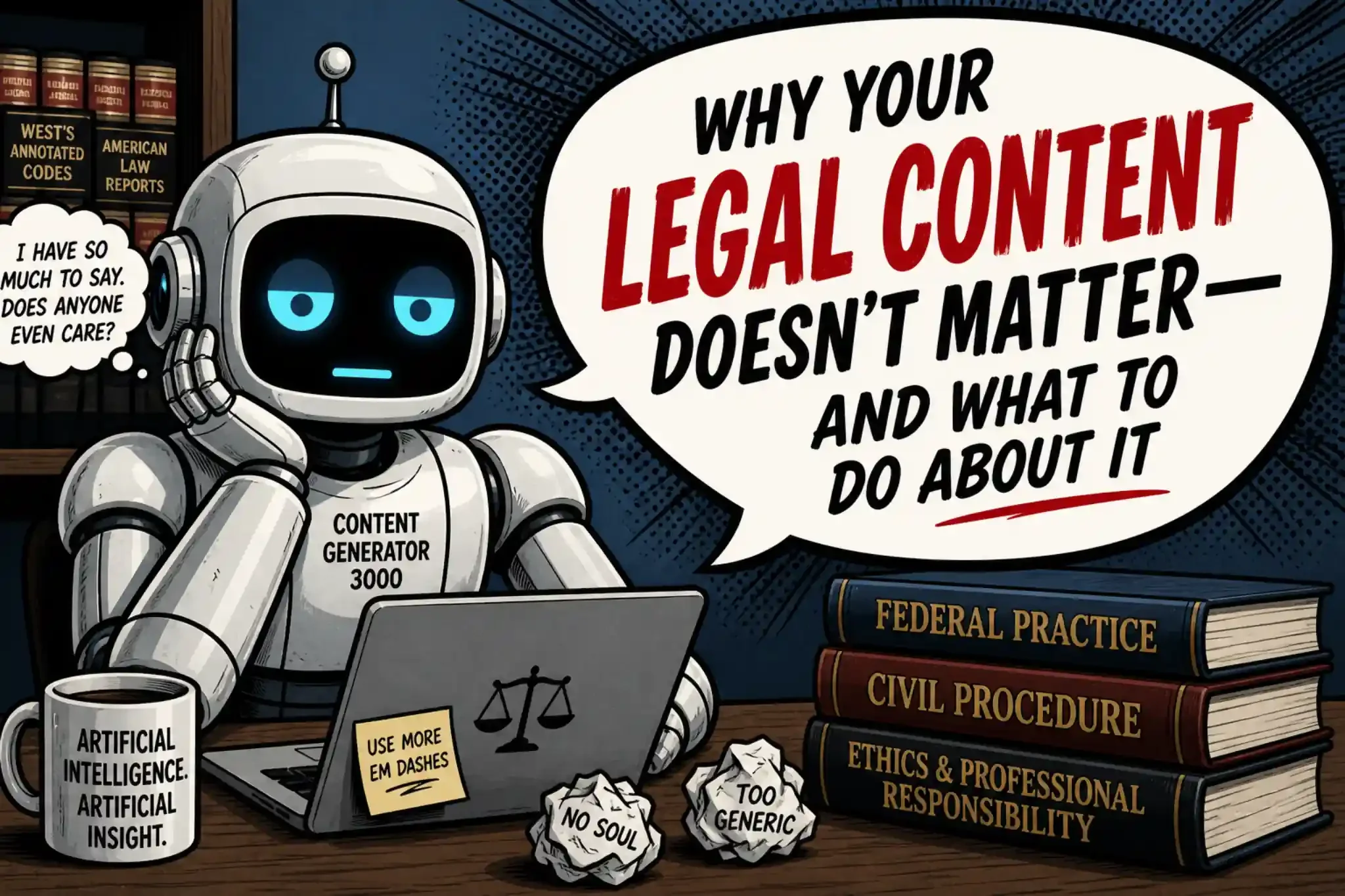
Is it disingenuous to use AI for a blog post about the pitfalls of AI-generated content? Nope, not when it comes to image generation. But when it comes to legal content, AI can crank it out quick, but it takes a human to make it worth reading.
Put yourself in the shoes of a potential client who has been harmed by, say, a medical device. Which sales pitch do you think would resonate more?
Option A:
“At [name of firm], our focus has always been on holding negligent parties accountable while driving meaningful outcomes for those we represent.”
Option B:
“You used a medical device because you were told it would help you heal. Instead, you were injured, left with more questions than answers, and now you’re wondering whether the company knew about the risks. We promise to help you understand what the legal options are and whether you may have a case. At [name of firm], we will do everything in our power to hold the responsible parties accountable and pursue the compensation you deserve.”
Leaning towards Option B?
Not that Option A is “wrong.” It just sounds more like a firm talking to other lawyers on LinkedIn than to someone actually looking for help. And it’s entirely possible that if a firm uses Option A verbiage, they could be one of the big sharks in their industry. But it’s likely their reputation and enormous marketing budget that’s generating new leads, not necessarily the organic content they’re publishing.
Heck, even this brief pitch would likely resonate more on an empathetic level with potential plaintiffs than Option A:
“At [name of firm], we go after the people who caused the harm and fight to make it right.”
AI Content Contains No Compelling Hook
You can often tell if legal content is 100% AI generated when there’s no hook. A hook is a compelling introduction to the story. It could be a scenario, a statistic, even a simple“Did you know?”
Hooks, in some form, establish an emotional connection with the reader that makes them subtly think to themselves, “I gotta keep reading.” Personally, I like leading with a scenario. Let’s take the Roundup weedkiller litigation as an example. A typical legal page for this vertical might begin, “If you or a loved one were exposed to Roundup and later diagnosed with non-Hodgkin’s lymphoma, you may be entitled to compensation.”
Perfectly mass-tort-firm-sounding, right? Sure, but the problem is that while there are a handful of firms that are driving the litigation, hundreds are competing for the same clients, and most of them sound exactly the same.
Now let’s edit the Roundup pitch with something less salesy and more heart-strings-pulling:
“For years, one of your greatest joys was gardening. Digging your hands in the soil, watching something grow because you took care of it made you feel connected to nature. Even weeding, a chore to most people, gave you a sense of purpose.
“Your garden was a utopia. And to help you keep it pristine, you used a popular product that you never suspected would uproot your life. You started feeling off, eventually experiencing fatigue and symptoms you couldn’t explain. And then you hear three words that change everything: non-Hodgkin’s lymphoma.
“Now you’re left wondering how this happened and whether something you trusted for years may have played a role.”
Obviously, for a short landing page, this scenario won’t work. But for a litigation explanation page, which do you think lands better with potential plaintiffs, a dry as a Sarah sandstorm intro or the “greatest joys was gardening” scenario?
Passive Vs Active Voice
Let’s revisit the intro, “Our focus has always been on holding negligent parties accountable.” Now, this may seem like we’re splitting grammatical hairs here, however "has always been" is weak.
Why not say, “Our focus is holding negligent parties accountable?”
To borrow a phrase from a common AI section headlines, here’s why this matters….
Readers are already inundated with content. Save them time and get your message across more clearly by trimming unnecessary words.
Now let’s revisit the next part of the Option A pitch, "while driving meaningful outcomes for those we represent."
Let’s edit that to “helping our clients get the results they deserve.”
AI-generated content is full of fluff. Without doubt, LLMs like ChatGPT do a pretty, pretty good at cranking out first drafts. The problem is that few firms bother to edit for clarity, succinctness, and empathy.
AI-Generated Legal Content Fails To Break Down Legalese Into Simple English (Even When Prompted To Do So)
Another example of a public-facing law firm pitch: “We advance transparency, strengthen recovery strategies, and shape the future of mass tort and class action litigation."
Um, what? What the heck is a mass tort? That’s what a normal person reading probably thinks right before their eyes glaze over.
As the attorney and legal writer David Meldofsky of Lawsuit Informer says in a Medium article he penned (typed):
"They [potential plaintiffs] may not know what a mass tort is. They may not know how a lawsuit differs from a class action."
Exactly.
And when people hear “mass tort,” this is probably closer to what comes to mind:

This article calls out unedited AI content, but credit where it’s due: the new ChatGPT image generator is legit!
Simple analogies are highly effective at explaining legal terms and concepts. For instance, “A class action splits one pizza evenly. A mass tort lets everyone order based on what they actually went through.”
This may seem to trivialize plaintiffs’ suffering and experiences. But here’s when you explain it further with empathy.
“Take the Uber sexual assault litigation. Every plaintiff may have experienced something deeply upsetting. But the harm isn’t the same across the board. Someone who was violently assaulted suffered a very different level of trauma than a passenger who was subjected to sexually inappropriate remarks. A mass tort recognizes these differences. As a result, compensation reflects what each person actually went through, not a one-size-fits-all outcome as is the case with a class action litigation.”
Examples of AI Giveaways
You can tell when something is AI-generated when the writing is formulaic.
For instance: It's not about [x], it's about [y].
Using an example that AI was prompted to generate (this is where AI comes in real handy when you’re stuck and can’t think of an example right away):
“It’s not about the process—it’s about the damage that was done and who’s responsible for it.”
What’s the problem with this trite formulaic rhetorical device?
Nothing necessarily, other than you’re showing that you’re not putting the time in to create original content; this may or may not have any effect on how many consultations will result from the article.
In addition to the lack of originality and authenticity, the other problem is similar to passive versus active voice. Use fewer words when possible. Don't tell readers what it's not about. Just jump right in and tell them what it's actually about. The “it’s not about [x], it’s about [y]” is so overplayed and it’s rarely used intelligently.
And here’s another overused AI devices: Short sentences that all start the same way like this:
“No upfront fees.
No risk.
No obligation.
Just results.”
This reads like a template. Your audience is likely inundated with this, and after a while, it starts to feel less like confident writing and more like fill-in-the-blank marketing copy.
“Why This Doesn’t Matter”
Insipid, dull section headlines are another dead giveaway that a piece of legal content is completely AI-generated. One of the biggest offenders is “Why This Matters.”
If everything matters, then nothing matters. (Whoa, that’s deep!) Millions of other articles use “Why This Matters.” If you want your content to impart authenticity and authoritativeness, then take the time to craft original section headers.
For instance, drawing from the Uber litigation again—I go back to that well frequently because I created a 20,000+ word SEO magnum opus guide to the Uber lawsuits—suppose a section discusses Uber changing its arbitration policy.
Sure, you can stick with “Why This Matters.” It’s actually a good road sign. It instantly tells the reader why it’s important. But wouldn’t it be better to have an original section header, “How Uber Changing Its Arbitration Policy Affects Survivors.”
That’s more impactful, right? Not to mention, it reads like an actual human wrote it (even if AI inspired it).
Why Em Dashes Matter—According to ChatGPT
ChatGPT loves using em dashes (these guys: —) to create a dramatic pause in a sentence. Many readers now realize that when they see too many long dashes, it means that it’s AI generated. Many law firms and attorneys attempt to “outsmart the system” by replacing em dashes with commas, as if that alone will fix the lack of originality and clarity in legal writing.
Most real writing rarely needs em dashes. They’re not bad for sales pages. But they’re mostly as unnecessary as a teenager who can’t go more than one sentence without saying “literally” or “like.”
While em dashes, emojis and other AI devices may not bother every reader, some people pick up on it. Those long dashes start to feel like the content wasn’t carefully written for them. “Like” the firm didn’t quite take the time to explain things clearly. (And like, yeah—that matters. : )
Philosophical Fluff
Similar to the it's not about [x], it's about [y], AI-generated content is rife with this kind of fluff:
“Sometimes you lose not because you failed, but because the outcome was never in your control.” (Whoa! Again, that's profound!)
Is this really resonating with readers, or it something that belongs on a motivational poster in a high school guidance counselor's office?
In the end, high-quality legal content sounds conversational, like something a real person wrote, understands what the reader is going through, and explains it in a way that actually makes sense.
Need Help Making Your Content Sound Not Like A Robot?
If your content reads like it was generated and published without a second thought, your potential clients can feel it.
We help law firms turn generic, AI-sounding content into clear, compelling pages that actually connect with readers and gently encourage them to receive a consult.
Let’s talk about your content →