
Publishing Legal Content for Sexual Abuse Survivors: It Should Read Like It Was Written for a Human Being
Exceptional legal content makes the law easier to understand, less intimidating and more human. That matters in every practice area, but especially when writing for survivors of sexual abuse and assault.
Lawyers have legitimate reasons to be careful with language.
They don’t want to overpromise. They don’t want to make a blanket statement about a statute of limitations when exceptions may apply. They certainly don’t want a website visitor interpreting general information as legal advice.
But there comes a point when being “legally precise” turns into writing that practically begs the reader to close the browser tab.
That’s a problem in any area of legal marketing.
For law firms representing survivors of sexual abuse and assault, however, it’s a much bigger one.
Someone visiting a page about doctor sexual abuse, rideshare assault, institutional abuse or another deeply personal experience may already be uncertain about whether what happened to them was wrong, whether anyone will believe them, whether too much time has passed or whether contacting an attorney is even worth it.
The content shouldn’t give them another obstacle to overcome.
Here’s What Legalese Sounds Like to an Actual Reader
Consider language along these lines:
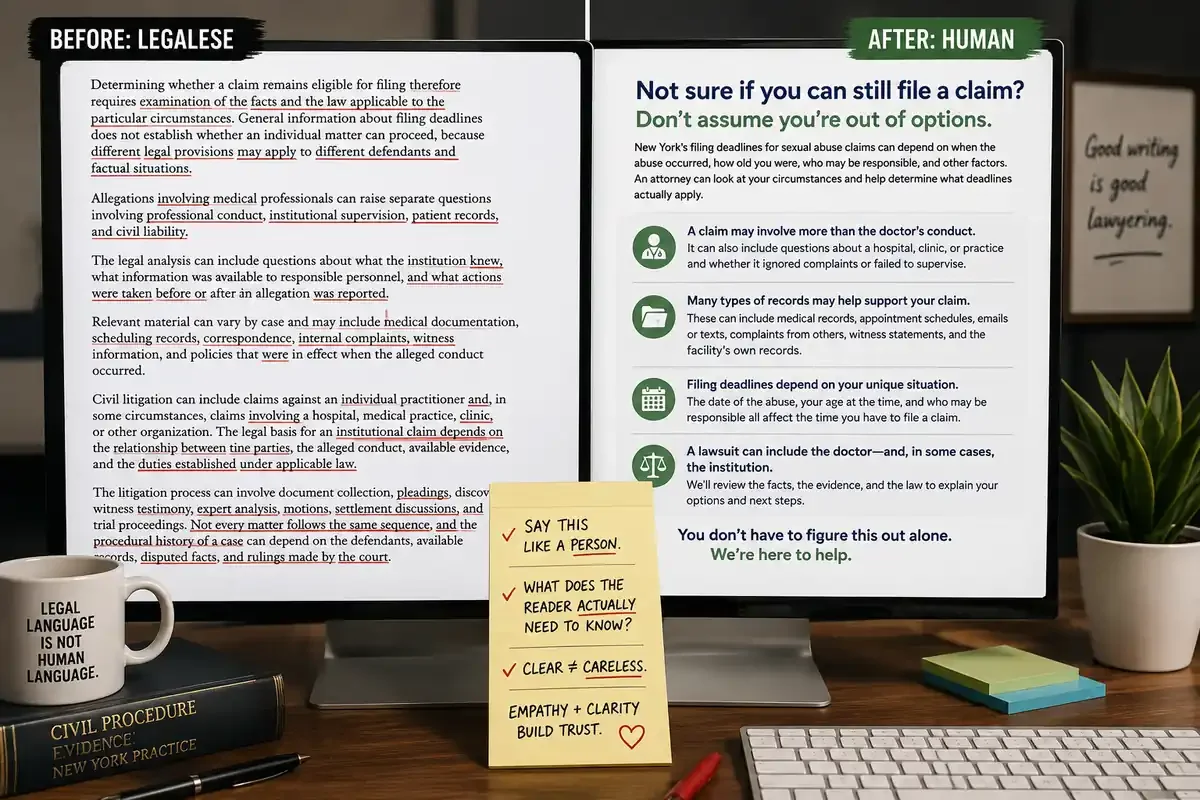
Determining whether a claim remains eligible requires consideration of the particular facts and applicable law. General filing-deadline information cannot establish whether an individual claim may proceed because different provisions can apply depending on the defendant and circumstances.
Um...what?
My eyes glazed over somewhere around “applicable law.”
Now imagine reading that after finally working up the nerve to search for information about sexual abuse you experienced.
What is the reader supposed to take away from it?
Probably something like:
This sounds incredibly complicated. Maybe I don’t have a case. Maybe I waited too long. Maybe I shouldn’t bother.
That’s almost certainly not what the lawyer intended to communicate.
Here’s what the same basic idea could sound like:
Not sure whether too much time has passed? Don’t assume you’re out of options. [STATE’s] filing deadlines for sexual abuse claims can depend on when the abuse occurred, how old you were, who may be responsible and other factors. An attorney can look at your circumstances and help determine what deadlines actually apply.
Sexual Abuse Content Requires a Different Level of Empathy
Legal websites frequently treat every practice area as though it should use the same writing template:
Describe the law.
List the evidence.
Discuss liability.
Explain litigation.
Add a contact form.
That approach may be merely boring on a commercial litigation page, but on a sexual abuse page, it can feel really cold.
Consider this statement:
Allegations involving medical professionals may raise separate issues involving professional conduct, institutional supervision, patient records and civil liability.
Technically, that’s true, but emotionally?
A survivor may be wondering whether a doctor crossed a line during an examination and whether the conduct they experienced was medically legitimate, so the content should start there!
Here’s how I would frame it:
Doctors are given an extraordinary amount of trust and access to their patients. When a physician uses an examination or treatment as an opportunity for sexual misconduct, it can leave a patient questioning what happened long after the appointment ends.
Now you can explain the legal issues:
A claim may involve more than the doctor’s conduct. Depending on the circumstances, questions can also arise about whether a hospital, clinic or medical practice received earlier complaints, ignored warning signs or failed to properly supervise the physician.
That sounds like it was written for the person reading the page rather than for another attorney reviewing it.
Stop Making Evidence Sound Like Discovery Responses
Here’s another common type of legal-content sentence:
Relevant evidence may include medical documentation, scheduling records, correspondence, internal complaints, witness information and policies in effect at the time of the alleged conduct.
Reworked for a more conversational tone:
You don’t necessarily need to have saved every piece of evidence yourself. Medical records, appointment schedules, emails, text messages, complaints from other patients, witness statements and the facility’s own records may all help show what happened.
This answers a question survivors may have:
What if I don’t have proof?
High-quality legal content anticipates the fear behind the search query instead of merely cataloging the evidence lawyers might eventually request in discovery.
Institutional Liability Can Be Explained Without Sounding Like a Law School Exam
Another passage in this type of content might explain that when both a physician and medical institution are involved, the “legal analysis” could examine what the institution knew, what information was available and what actions personnel took.
But there’s a much more compelling way to say that:
“Sometimes the question isn’t only what the doctor did. It’s what the medical institution did or failed to do about it.
Were there previous complaints? Did another employee notice inappropriate behavior? Was the physician disciplined before? Did administrators have warning signs and allow the doctor to continue treating patients anyway?”
Now the reader understands why institutional responsibility matters for their case. Attorneys may be worried that this type of conversational language dumbs down the law. It does not; it’s merely more simply explained.
Nobody Needs a Tour of the Entire Litigation Process
Legal websites also have an inexplicable affection for sentences like:
Litigation may involve pleadings, discovery, witness testimony, expert analysis, motions, settlement discussions and trial proceedings.
But does someone who just searched “doctor touched me inappropriately during exam” need a miniature civil-procedure syllabus?
Probably not.
The reader is much more likely to want to know what happens first.
So instead, the content could say:
“Talking with an attorney doesn’t mean you’re committing to a lawsuit or preparing to testify in court tomorrow. The first step is usually much simpler: explaining what happened, reviewing what information may be available and determining whether you may have a legal claim.”
If the page later needs to explain discovery or depositions, fine.
Give readers information when they need it.
Write for the Question the Survivor Is Actually Asking
Someone who lands on a sexual abuse attorney’s website usually isn’t researching the abstract contours of civil liability for recreational purposes.
Behind the search may be questions such as:
Was what happened to me abuse?
Could the hospital have stopped it?
Will anyone believe me?
What if I never reported it?
What if it happened years ago?
Do I need evidence?
Am I going to have to face this person again?
The strongest legal content starts with those questions and then brings in the law.
Too much attorney-written content does the exact opposite. It starts with legal doctrine and hopes the reader sticks around long enough to figure out whether any of it answers their question.
Sounding Human Matters For Legal Content
Every law firm should strive for clear, readable content.
But sexual abuse and assault law deserves particular care.
These aren’t people comparison-shopping for a trademark lawyer.
Some visitors may be researching an experience they have never spoken about before. Others may have spent years blaming themselves, doubting their memories or assuming nothing could be done.
They shouldn’t have to decode attorney-speak on top of everything else.
Being survivor-centric doesn’t require turning a law firm website into therapy.
It means recognizing who is reading.
Explain what happened in plain English. Acknowledge the questions they’re likely to have. Use the law to clarify their options rather than demonstrate how complicated the law can be.
Because if your legal content is technically flawless but leaves the person you want to help thinking, “Um...what?” … then you haven’t communicated very much at all.
This is a topic close to my heart in my work as editor of SurvivorsRights.com, where legal information involving sexual abuse and institutional accountability has to be accurate without becoming cold, intimidating or buried under legal jargon.
Need Someone to Make Your Legal Content Sound Like It Was Written for Actual People?
That’s exactly what LawFirmContentManager.com is built for. I help law firms revise overly technical, generic or AI-sounding legal content into writing that is clearer, more conversational and better aligned with the people actually searching for help—without sacrificing legal accuracy, SEO value or professional credibility. If your website sounds more like a pleading than a conversation with a prospective client, it may be time for an edit.
