
10 Steps to Maximize On-Page SEO for Law Firm Content Before You Hit Publish
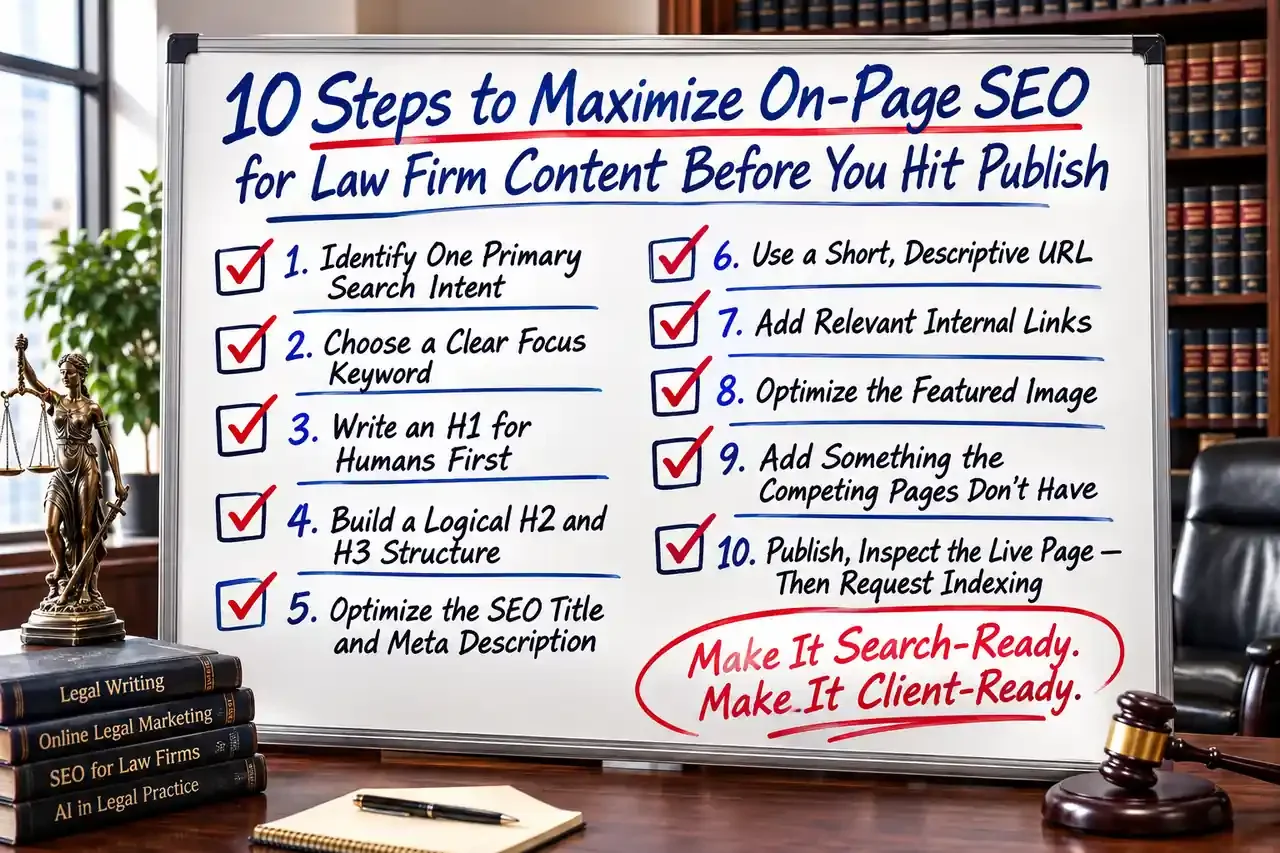
Following these 10 steps might seem like a pain. That’s one reason LawFirmContentManager.com exists: to make sure your legal content is optimized, polished, and ready to compete before you hit publish.
Writing a comprehensive, authoritative law firm article is only part of the job.
You can spend hours researching a legal topic, carefully explaining complicated concepts, and producing genuinely useful content only to undermine much of that work by publishing the article without properly optimizing the page.
One thing hasn’t changed since Google began cracking down on black-hat SEO tactics in the early 2010s: even in today’s AI-driven search landscape, certain on-page SEO principles remain cardinal rules. On-page SEO doesn’t mean stuffing keywords into every available heading. It means giving Google, AI search platforms, and, most importantly, prospective clients a clear understanding of what the page is about.
Before publishing your next law firm article, run through these 10 steps.
1. Identify One Primary Search Intent
Start with the question:
What is the person searching for this page actually trying to accomplish?
Consider three people searching for:
“what happens after filing a personal injury claim”
All three individuals may eventually need an attorney, but they are at very different stages of the decision-making process.
Your article should satisfy the primary search intent first.
Trying to make one page rank for every remotely related keyword usually produces an unfocused article that serves none of them particularly well.
2. Choose a Clear Focus Keyword
Every page should have a primary topic that can be summarized in a few words.
That doesn't mean the exact phrase needs to or should appear 17 times.
However, it does mean the keyword, along with natural variations and related terminology, should help shape the following on-page SEO attributes:
Title
H1
URL
opening paragraphs
subheadings
body copy
image alt text
SEO title
meta description
The focus keyword is like the page's guiding north star.
3. Write an H1 for Humans First
Your H1 tag should make the subject of the page unmistakable.
For law firms, clarity usually beats cleverness.
A headline such as:
California Sexual Abuse Statute of Limitations: How Long Do Survivors Have to File?
immediately tells both the reader and search engine what the page provides.
Compare that with something vague like:
Understanding Your Rights Under California Law
The second may sound polished, but it gives Google and the reader far less information.
Your H1 can still be compelling; it shouldn't sacrifice specificity to get there.
4. Build a Logical H2 and H3 Structure
Subheadings aren't merely formatting devices.
They create the information architecture of the page.
A well-structured legal article allows someone to scan the page and understand the major questions it answers without reading every paragraph.
For example:
What Is the California Sexual Abuse Statute of Limitations?
How Did California's Lookback Window Work?
Can Adult Survivors Still File Claims?
What Happens If the Abuse Occurred Decades Ago?
How Can an Attorney Help?
That structure helps traditional search engines understand the page, but it may become even more important as AI-driven search systems extract individual passages to answer specific questions.
Competent and effective SEO increasingly means making individual sections understandable on their own.
5. Optimize the SEO Title and Meta Description
Your on-page H1 and your SEO title don't necessarily need to be identical.
The SEO title has a different job: earning the click from a search results page.
That often means combining the primary keyword with an immediate benefit or reason to investigate.
For example:
California Sexual Abuse Statute of Limitations | Filing Deadlines
The meta description should then expand the value proposition:
Learn California's current sexual abuse filing deadlines, how previous revival windows worked, and whether survivors may still have legal options.
Neither element should read like it was written for a robot because keywords get you into the conversation while relevance and clarity help earn the click.
6. Use a Short, Descriptive URL
URLs should generally be concise and understandable.
Instead of:
/blog/2026/08/understanding-everything-you-need-to-know-about-california-sexual-abuse-laws-and-lawsuits/
something like “/california-sexual-abuse-statute-limitations/” is cleaner.
Avoid changing established URLs casually, particularly when a page already has backlinks or search visibility. But when creating new content, keep the slug focused from the beginning.
7. Add Relevant Internal Links
Internal linking is one of the most overlooked opportunities on law firm websites.
Every new article creates opportunities to strengthen other pages and every existing authoritative page can potentially strengthen the new one.
A news article about a Catholic diocese settlement, for example, could naturally link to:
the relevant state attorney page
another related institutional abuse case
(Several of the links in this post point to SurvivorsRights.com, for which I serve as managing editor.)
Internal links also help prospective clients continue researching without leaving your website.
Don't insert links merely because you can.
Ask:
What would the reader logically want to understand next?
That's usually where the best internal link belongs.
8. Optimize the Featured Image
Images can contribute to the page beyond making it look better.
Before uploading a featured image:
use a descriptive file name
compress the image to avoid unnecessary page weight
use an efficient format such as WebP when appropriate
add meaningful alt text
avoid stuffing the alt text with keywords
For an article about a courthouse sexual abuse lawsuit, for example, alt text such as “California courthouse where a sexual abuse lawsuit may be filed” provides context. In comparison, “sexual-abuse-lawyer-attorney-lawsuit-best-law-firm.jpg” does not.
Alt text should primarily describe the image.
9. Add Something the Competing Pages Don't Have
This may be the most important step.
Before publishing, ask:
Why should this page exist?
If you've merely rewritten information already available on ten competing websites, perfectly optimized title tags probably won't save it.
Law firm content becomes stronger when it adds original value.
That might include:
updated filing deadlines
recent verdicts or settlements
jurisdiction-specific information
timelines
explanations of what happens next
FAQs derived from real client concerns
comparisons between different legal options
links connecting recent developments to a larger legal resource
practical guidance for people considering a claim
This is also where old-school editorial standards and modern AI search strategy intersect.
AI can help identify entities, questions, related topics, and information gaps.
But the goal isn't to produce more words. Rather, it's to publish a page that deserves to be retrieved.
10. Publish, Inspect, Request Indexing
Don't assume the job ends when you click Publish.
Open the actual page.
Check:
the H1
headings
spacing
internal links
outbound links
featured image
mobile appearance
title and description settings
canonical URL
accidental noindex settings
Then make sure Google knows the page exists.
For important new pages, Google Search Console's URL Inspection tool allows you to inspect the URL and request indexing.
Requesting indexing isn't a magic ranking button.
It simply removes one unnecessary variable from the process: waiting for Google to discover the page on its own.
For strategically important law firm content, I see little reason to leave that to chance.
On-Page SEO Is Really an Editorial Process
There was a time when on-page SEO could feel like a technical checklist added after the writing was finished.
That's increasingly the wrong way to think about it. A better way to think about it is it’s an extension of the meticulous editing process. At the end of the day, the winning formula is:
Write for your audience. Structure the article for search. Add information worth finding. Then make sure the search engines can actually find it.
Need Someone to Make Sure Your Law Firm Content Is Fully Optimized Before It Goes Live?
From keyword targeting and page structure to internal links, metadata, image optimization, and indexing, LawFirmContentManger.com can help make sure your law firm content is positioned to perform in both traditional and AI-driven search.
