
Before Publishing New Content, Audit Your Existing Pages for Better SEO Results
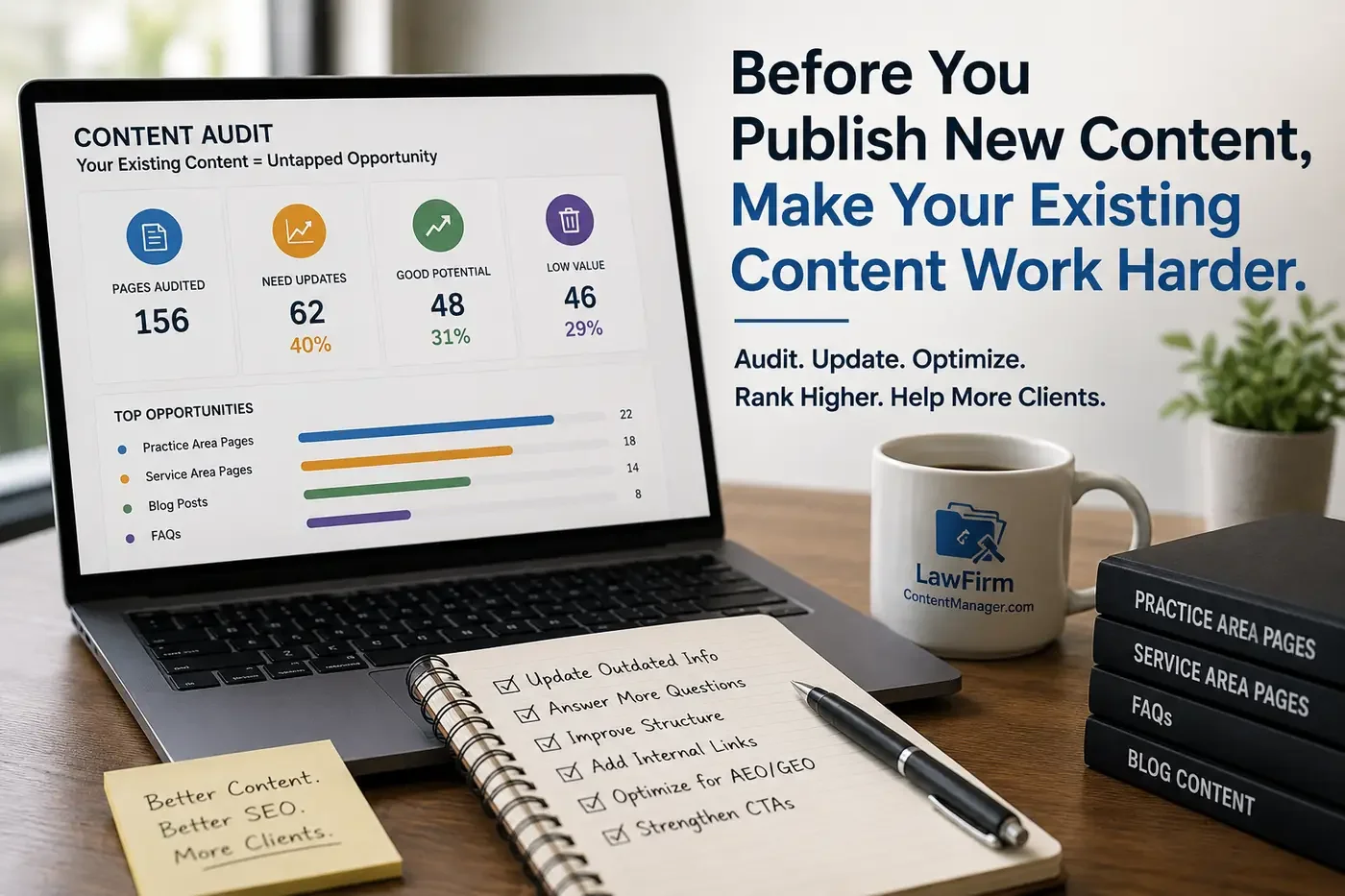
Before publishing more content, audit what your firm already has. Updating strong existing pages can improve usefulness, search visibility, and readiness for AI-powered search.
Your law firm has not published a new blog post in several weeks. A competitor recently added three new service-area pages, so someone on your marketing team suggests increasing the monthly content calendar.
Is the obvious next step is to publish something new and try to keep up with the SEO legal Joneses?
Not necessarily.
Before adding another page to your website, it may be worth asking:
What useful content is already sitting on your website, quietly becoming outdated?
Many law firm websites don’t have a content shortage. Instead, they have a content-management problem.
Their websites contain practice-area pages written years ago, outdated blog posts that still receive search impressions and FAQs that no longer reflect the questions prospective clients are asking.
Publishing more content may feel productive. But in some cases, improving what the firm already owns can be the better use of time and budget.
Newer Does Not Automatically Mean Better
Law firm websites often grow one page at a time.
A new practice area is added. A blog post is published in response to a legal development. Several location pages are created for a new geographic market. An older article continues appearing in search results long after anyone at the firm has reviewed it.
Eventually, the website becomes a patchwork of content created by different writers, agencies, attorneys, and AI tools.
Some pages may be excellent. Others may be thin, repetitive, legally outdated, or disconnected from the firm’s current priorities.
Adding more pages does not solve those problems. It may compound them.
Before commissioning another generic article, take inventory of the content already on your website and ask:
Is the information still accurate?
Does the page reflect the services the firm currently wants to promote?
Does it answer the questions prospective clients actually ask?
Could the same copy appear on a dozen competing law firm websites?
Is the page organized clearly enough for both readers and search systems to understand?
Does it lead naturally to another useful page or a relevant next step?
A page does not stop needing attention simply because it has already been published.
Start With Pages That Already Show Signs of Life
Not every old page deserves to be saved.
Some topics are no longer relevant. Some pages never attracted meaningful interest. Others may overlap so heavily that combining or removing them makes more sense than rewriting them.
The most promising refresh candidates are often pages that already show evidence of demand.
For example, an older article may still receive impressions in Google Search but attract few clicks. A practice-area page may bring visitors to the website without encouraging them to explore further. A blog post may answer part of a question but fail to connect that information to the firm’s related legal services.
These pages have already established some degree of visibility. The opportunity is to make them more useful.
That might involve revising the title, strengthening the opening, improving the page structure, adding attorney insight, answering missing questions, updating internal links, or clarifying what the reader should do next.
Instead of starting from zero, you are improving an asset that has already shown potential.
How To Make Meaningful Updates To Pages
Accuracy is the most obvious reason to revisit older legal content because legislation can evolve or filing deadlines (lookback windows) can expire or expand. Or perhaps an agency has issued new guidance or a massive global settlement has been reached, essentially halting docket expansion.
Moreover, a page that was accurate two years ago may now omit an important development or contain information that is no longer reliable.
But a meaningful content refresh should involve more than changing a date or replacing one paragraph.
Ask whether the page still reflects how prospective clients think about the issue today.
Perhaps the original article explains the legal standard but never addresses cost. Maybe it describes who can file a claim but does not explain how long the process may take. Perhaps it discusses a broad category of litigation without answering the narrower questions that now appear during intake calls.
Look for Generic Copy Hiding in Plain Sight
Older practice-area pages often rely heavily on familiar legal-marketing language:
We understand how difficult this time can be.
Our experienced attorneys will fight for the compensation you deserve.
Contact us today for aggressive and compassionate representation.
None of these statements is necessarily false. The problem is that they reveal almost nothing distinctive about the firm.
A content refresh creates an opportunity to replace broad claims with specifics.
What does personal attention actually mean at your firm? Who communicates with the client? How does the firm investigate this type of matter? What mistakes do attorneys repeatedly see people make before seeking representation? What does the firm understand about these cases that a generic writer would not know?
The strongest updates incorporate real attorney knowledge rather than simply rearranging familiar sales language.
Revisit the Pages Closest to Revenue
A law firm blog can attract attention, but practice-area and service pages are often closer to the decision to contact an attorney.
Those pages deserve regular scrutiny.
Review whether each one:
Clearly identifies the legal service being offered
Speaks to a recognizable client situation
Explains the relevant issues in plain English
Addresses common concerns and objections
Reflects the firm’s actual experience and approach
Includes a clear path to related information
Gives the reader a sensible next step
A page about car accident claims, estate planning, business formation, divorce, or criminal defense should not read like a lightly modified version of every competitor’s page.
It should reflect the questions, priorities, and concerns of the people the firm hopes to serve.
Strengthen the Connections Between Existing Pages
Sometimes the content itself is solid, but the website treats every page like an island.
A blog post may explain what happens after a workplace accident without linking to the firm’s workers’ compensation page. A service-area page may mention a specific case type without connecting readers to the more detailed practice-area content. A frequently asked question may be answered in three separate places using three slightly different explanations.
Refreshing content should include reviewing how pages relate to one another.
Thoughtful internal links help readers continue exploring the subject without forcing them back to the navigation menu. They also help search engines discover and understand relationships among pages. Google specifically recommends making links crawlable and using descriptive language that helps search systems interpret content.
Internal linking should not mean inserting the same keyword-rich link into every paragraph. It should make the website easier to navigate and show how the firm’s information fits together.
Keep the Editing Old-School
AI can help identify opportunities, organize information, draft FAQ schema, summarize source material, and accelerate portions of the editing process.
But AI should not trump final human judgment.
Older content often needs nuanced decisions that cannot be reduced to “rewrite this page with better SEO.”
An editor must decide what should remain, what has become obsolete, what deserves expansion, what sounds generic, and what only an attorney can credibly add.
That requires reading the page closely.
It requires checking the legal substance, evaluating the tone, comparing the content with competing pages, and asking whether the revised version truly helps a person understand the issue.
Use AI as an assistant but keep the editing old-school.
Google’s guidance does not prohibit the use of generative AI, but it emphasizes accuracy, quality, relevance, and useful content rather than automation for its own sake.
Modernize the Page for AEO and GEO
Traditional editing and modern AI-search strategy are not competing approaches.
The strongest content does both.
Answer engine optimization and generative engine optimization are commonly used to describe efforts to make content easier for search engines and AI-powered systems to interpret, extract, and potentially cite.
That does not mean filling every page with robotic definitions or chasing a supposedly secret AI-search formula.
Google says the same foundational SEO practices remain relevant to AI Overviews and AI Mode, and that there are no special additional requirements for inclusion. Its newer guidance emphasizes valuable, original, non-commodity content rather than gimmicks designed solely for generative search.
For an older law firm page, an AI-search refresh may include:
Adding a clear answer near the top of the page
Breaking complicated topics into descriptive sections
Including common client questions and direct responses
Identifying the attorney or firm responsible for the content
Citing reliable primary sources where appropriate
Updating stale facts, dates, and legal developments
Clarifying geographic and jurisdictional relevance
Adding relevant structured data
Strengthening connections to related pages
These improvements help human readers first. They also make the page easier for search systems to process. (Learn more about this here.)
Add Questions Worth Answering
Older pages frequently omit the questions prospective clients care about most.
A personal injury page may explain negligence but never discuss medical bills. An estate-planning page may define a trust without addressing whether the reader actually needs one. A business-law page may describe contract disputes but avoid discussing cost, time, or the effect on an ongoing commercial relationship.
Adding a useful question-and-answer section can strengthen an existing page considerably.
The questions should come from real search behavior, intake calls, consultation notes, attorney experience, and recurring client concerns.
They should not be invented merely to create more headings.
Where appropriate, visible questions and answers can also be supported with structured data. Structured data helps Google understand page content and may make certain pages eligible for enhanced search appearances, although it does not guarantee rankings, rich results, or inclusion in AI-generated responses. Google also says there is no special schema required for generative AI search.
The code should reflect what readers can actually see on the page. It should not be used to hide additional claims or manufacture relevance.
Consolidate Pages That Compete With Each Other
More is not always more.
A law firm may have several pages targeting nearly identical topics:
Car accident lawyer
Auto accident attorney
Motor vehicle collision claims
Injured in a traffic accident
Local car crash representation
If each page offers essentially the same information, the website may be creating unnecessary duplication rather than useful topical depth.
In some cases, the better strategy is to consolidate several weak pages into one strong, comprehensive resource.
The same applies to old blog posts covering successive developments in the same litigation. Rather than leaving readers to piece together five partially outdated articles, the firm may benefit from maintaining one authoritative guide and linking to narrower news updates where appropriate.
A content audit should identify where pages complement one another and where they simply compete for the same purpose.
Refresh the Call to Action
Calls to action age too.
An older page may end with a generic instruction to “contact our attorneys today.” Another may use a phone number that is difficult to tap on mobile or direct readers to a form that no longer matches the service described.
The closing should follow naturally from the page.
A reader who has just learned about a complex claim may need reassurance about what happens during an initial consultation. Someone researching a transactional service may want to know what documents to gather. A business owner may prefer a discreet conversation rather than an urgent litigation-style message.
The call to action should reflect the reader’s likely state of mind instead of defaulting to the same language across the entire website.
Measure the Updated Page
A content refresh is still a strategy, not a guarantee.
After making substantial changes, track what happens.
Depending on the page, useful indicators may include:
Search impressions
Click-through rate
Organic visits
Time spent on the page
Visits to related service pages
Form starts or submissions
Calls attributed to the page
Queries bringing people to the content
Not every improvement appears immediately, and no single metric tells the whole story.
The purpose is to determine whether the updated page is becoming more visible, useful, and connected to the firm’s broader marketing goals.
Your Website Is Not a Finished Publication
Law firm websites are often treated as though each page becomes permanent the moment someone clicks “publish.”
But legal content should evolve as the law changes, the firm grows, client questions shift, and search technology develops.
That does not mean endlessly rewriting every sentence. But at least every once in a blue moon, have a content strategist review whether the website still represents the firm accurately and serves the people who rely on it.
Before adding another article to the content calendar, look closely at what is already there.
Your firm’s next strong piece of content may not need to be written from scratch.
It may simply need to be found, reconsidered, and made useful again.
Is Your Best Law Firm Content Already on Your Website?
Before publishing another page, find out whether your existing practice area pages, service area content, FAQs, and older posts could be updated to improve visibility, usefulness, and AI search readiness.
