
AEO and GEO for Law Firms: How Attorneys Can Show Up in AI Search Results
There is a new opportunity in legal marketing, one that does not require feeding the Google gods or Meta’s ad machine endless piles of cash.
That alone should get a lawyer’s attention.
Because let’s be honest: most firms are already fighting uphill. The biggest firms have deeper pockets, bigger teams, stronger back link profiles, and entire marketing departments devoted to staying visible via Search Engine Optimization (SEO.)
Smaller and midsize firms try to compete while also doing the actual work of lawyering: preparing for hearings, managing staff, handling intake, responding to clients, and trying not to drown in admin. In that environment, aimlessly throwing more money at SEO is likely not a winning strategy.
Meanwhile, search itself is changing under everyone’s feet (or at their fingertips). Gartner predicts that traditional search engine volume would drop 25% by the end of 2026 as users shift toward AI chatbots and virtual agents. Google’s CEO, Sundar Pichai, said during the search monolith’s own Q1 2025 earnings remarks, that AI Overviews already reach more than 1.5 billion users per month.
So here’s the opportunity….
While many firms are still obsessing over blue-link rankings alone (the old-school organic search listings, as opposed to Google’s AI-generated summary at the top), relatively few are seriously optimizing for AI answers and AI citations. That is where AEO and GEO come in.
Before your eyes glaze over, know this: You need not become an SEO wizard to understand them. What you do need to understand right now is how people search today.
What Are AEO & GEO (Explained Simply)?
When someone types a question into Google, they may see an AI-generated summary before they ever scroll to the standard organic results. When they ask ChatGPT, Gemini, Claude, Perplexity, or other AI platforms a legal question, they may get a synthesized answer instead of a list of websites. This is a legal marketing game-changer.
McKinsey reports that half of consumers already use AI-powered search; about 50% of Google searches already have AI summaries. Moreover, trend analysis points to AI summaries appearing on more than 75% of searches by 2028.
Do these stats have your attention? If so, it’s time to familiarize yourself with the two most important acronyms:
AEO stands for Answer Engine Optimization.
AEO strategy structures your content so AI assistants, Google answer boxes, and voice search tools can easily pull a direct answer from your page. AEO is mainly about making your content easy for a search engine or AI system to extract as a direct response to a search query/question. The purpose of AEO is to make the answer easy for AI to find, understand, and pull into a response. In the legal marketing space, ‘AEO’ could also stand for Attorney Engagement Optimization.
Now, as for GEO….
it stands for Generative Engine Optimization.
GEO strengthens your content and brand signals so AI systems are more likely to trust, summarize, cite or recommend your firm in generated responses. The SEO data company Semrush defines GEO as optimizing content to appear in responses generated by AI-powered search engines such as ChatGPT, Google, Perplexity and Claude.
The easiest way to think about it is this:
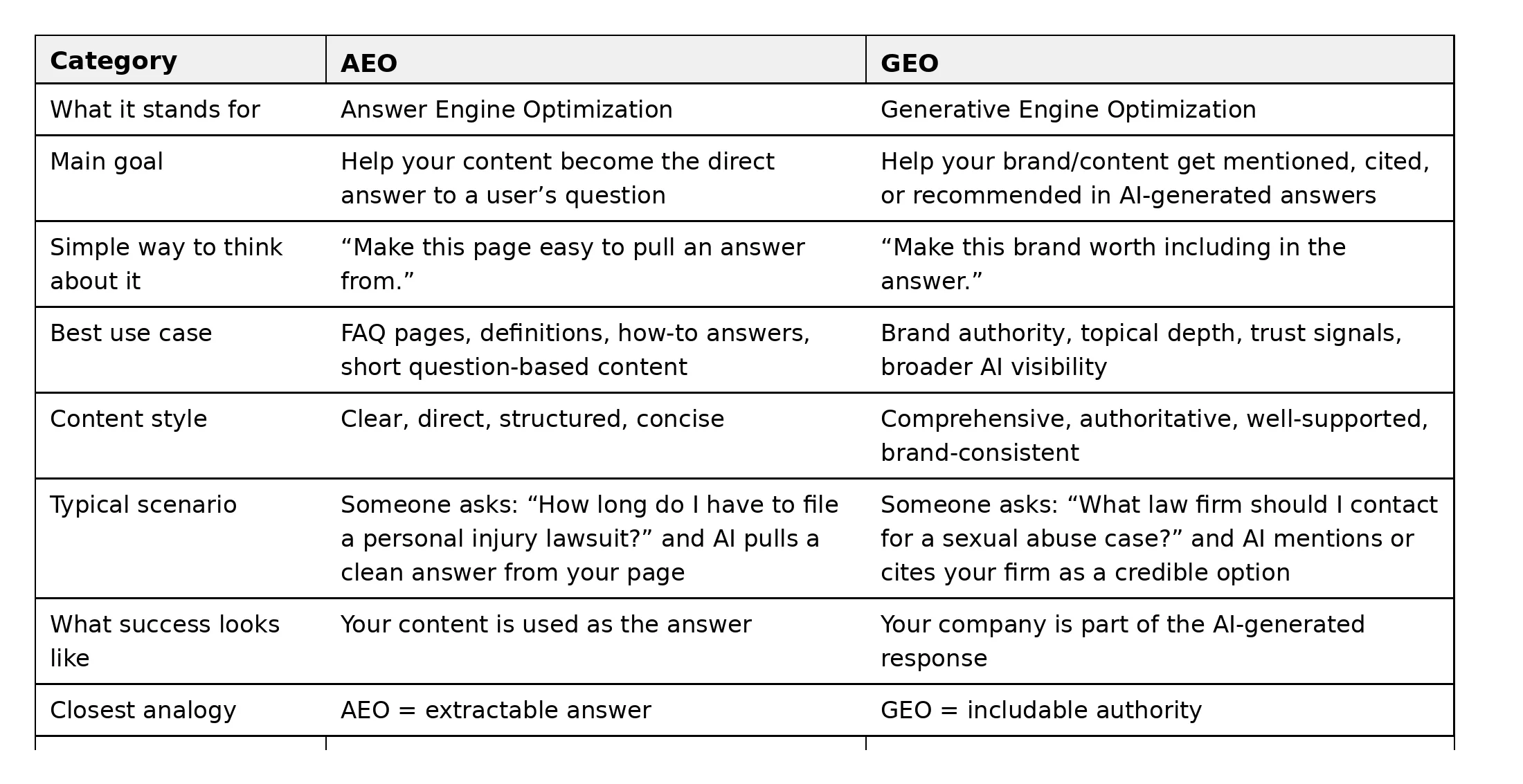
AEO is about being the answer.
GEO is about being part of the AI-generated answer.
Or even shorter:
AEO helps Google Search, Google Gemini, ChatGPT, Perplexity, and other AI tools pull useful answers from your content.
GEO helps AI tools choose your firm as a source to include in the answer.
No, AEO does not officially stand for “Attorney Engagement Optimization.” But if you’re an attorney, that’s how you should think of the acronym, because if your content is not built to answer real legal questions clearly, it is going to be a lot harder for potential clients to find and engage with your firm in AI search.
Why Law Firms Should Prioritize AEO and GEO
Legal search is not like using Google to shop for socks. Legal searches are usually high-stakes, emotional, tied to urgent life problems. People looking for a lawyer are often scared, confused, under time pressure and trying to figure out who they can trust with a problem that could affect their family, freedom, finances or future.
Potential clients ask high-stakes questions in online searches, such as:
“How long do I have to file a personal injury lawsuit?”
“Can I sue my employer for wrongful termination?”
“What should I do after an Uber sexual assault?”
“Do I need a lawyer for a custody dispute?”
“Who is a good attorney in [name of city] for clergy abuse claims?”
The above examples are highly competitive, high-intent long-tail SEO searches. And while traditional SEO still matters, there is now another question law firms need to ask: can AI systems understand your content, pull from it, and cite it?
If your firm doesn’t get ahead of the AEO/GEO curve, don’t say you weren’t warned. Pew Research Center reported that 58% of respondents conducted at least one search in March 2025 that produced an AI-generated summary. Not only that, users were less likely to click links when an AI summary appeared. In other words, if your firm is invisible in the summary layer, you may be losing visibility before organic rankings even get a chance to work.
AEO vs. GEO
Here is the clean distinction lawyers can actually use.
With AEO, you are creating content that answers common questions clearly, directly, and in a structured way. Think FAQ pages, glossary pages, statute-of-limitations explainers, “what happens next?” pages, and short sections that answer one question cleanly near the top.
With GEO, you are building a broader content ecosystem that tells AI systems: this firm knows what it is talking about, covers this topic deeply, updates content when the law changes, and deserves to be surfaced when someone asks who to trust.
AEO is the page that answers:
“How long do I have to file a personal injury lawsuit?”
GEO is the broader authority that helps AI respond to:
“What law firm should I contact for a sexual abuse case?”
The reality is that many law firm websites have pages that are stuffed with marketing language, thin on actual answers, vague on legal nuance, and too self-promotional to be useful. AI systems are not sentimental. They do not reward chest-thumping. They reward clarity, structure, specificity, relevance and trust signals.
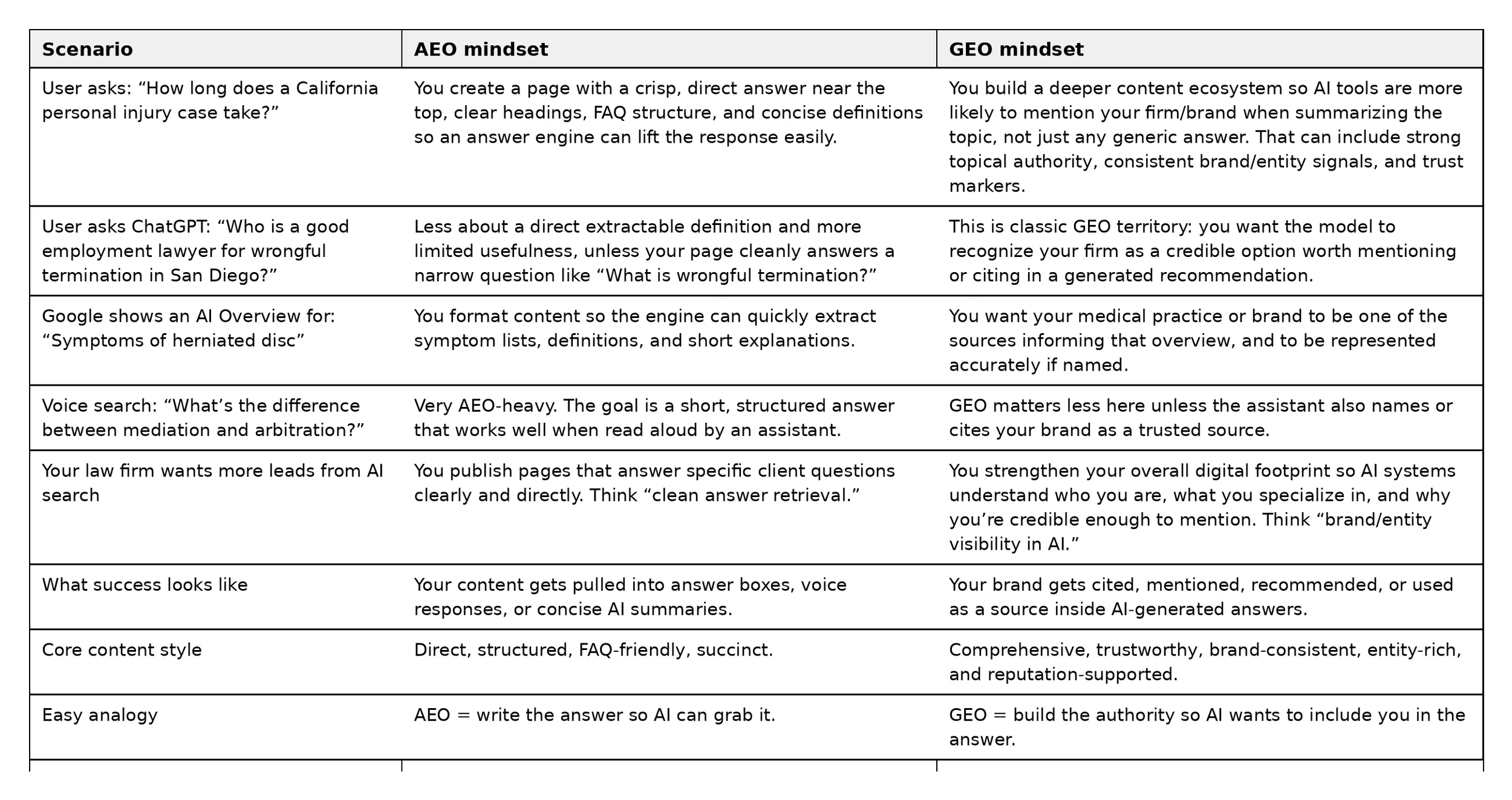
If AEO is about giving AI something clean to quote, GEO is about giving AI a reason to trust your firm enough to name-drop it.
How Small and Midsize Law Firms Can Boost Visibility Without Spending A Fortune
This is why there is an opening.
Hard adoption numbers specific to the labels “AEO” and “GEO” are still fuzzy because the terms are new and many teams are doing the work without calling it that. But the broader movement is already real. HubSpot reports that more than 92% of marketers either plan to use or are already using SEO optimization for both traditional and AI-powered search engines, and nearly 24% are specifically exploring updates to SEO strategy for generative AI in search. SurveyMonkey separately reports that 88% of marketers use AI in their day-to-day roles.
In other words, the marketing world is moving. Yet some firms are still using a 2010 playbook for online visibility.
That lag creates opportunity for firms that are willing to act before this becomes standard operating procedure.
AEO Law Firm Example
AEO is less about flash and more about function. It comes down to publishing pages that do the following important marketing operations very well. AEO pages:
Answer the question quickly.
Use clear headings.
Define terms in normal English.
Break process explanations into steps.
Get to the point instead of burying the answer under generic intro language.
Include FAQ-style formatting where appropriate.
Employ structured data and intelligent page architecture so search systems can interpret the content.
If any of this sounds vague, let’s use an example…..
Say a user asks, “How long does a California personal injury case take?”
A weak page gives them 1,500 words of generic filler and a last paragraph sales pitch.
A stronger AEO page gives them a direct, honest answer near the top: it depends on liability, injuries, treatment timeline, insurer cooperation, and whether the case settles or goes into litigation. Then it elaborates with subheads, examples, and a short FAQ.
That kind of content is easier for Google, ChatGPT, or Perplexity to parse and reuse.
Law Firm GEO Scenario
GEO is broader.
It is not just one page. It is the cumulative picture your firm creates online, including:
Practice-area depth
Recurring updates on evolving litigation
Consistent author and firm identity signals
Trust-building references and citations
Off-site mentions and digital footprint
Well-organized topical clusters
Content that sounds informed rather than promotional
McKinsey notes that a brand’s own site may represent only 5% to 10% of the sources AI search references, depending on the query and platform. That means AI visibility is not only about what is on your site. It is also about whether your site is the kind of source AI systems trust enough to include, and whether your broader digital footprint reinforces that trust.
This is one reason many law firms are vulnerable. They may have a decent homepage and a few service pages, but they do not have enough topical depth to become a credible AI source.
Or their site reads like it was written to impress a partner in 2014, not to answer a panicked client’s question in 2026.
Old-school SEO still matters. It just may not be enough on its own if AI search tools are pulling answers and recommendations from your competitors’ websites instead of yours.
AEO and GEO do not replace SEO. They add a new layer to the SEO work you are already doing.
You still need the SEO basics on your site:
Proper headers
Thoughtful title tags and metadata
Schema where appropriate
Internal links
Clean technical structure
Google-crawlable pages
Strong service pages
Updated content
But the style of winning content is changing. Overly promotional writing tends to perform poorly in AI environments because it is less useful as an answer source. AI systems gravitate toward pages that explain, clarify, compare, define and substantiate. That is why many of the strongest GEO articles on the web do not start by screaming the brand name in paragraph one. They lead with the answer, build credibility through substance, and let the brand benefit from being the helpful source.
For law firms, that is a feature, not a bug. The firms that teach clearly often earn trust quietly.
A Law Firm AI Search Comparison
Imagine two firms both handle employment law in San Diego. (I’m using ‘America’s Finest City’ as an example not only because I love the Anchorman series, but because I’ve lived here since 1999.)
Firm A has a page titled “Wrongful Termination Lawyer San Diego” that mostly repeats the phrase “experienced attorney” and asks visitors to call now.
Firm B has a page that clearly explains what wrongful termination is, what facts may support a claim, what evidence matters, how deadlines work, what damages may be available, and when someone should speak to counsel. It also has related pages on retaliation, discrimination, severance issues, and administrative exhaustion, all linked together in a coherent cluster.
Which one is easier for AI to pull from? Which one sounds more trustworthy? Which one is more likely to be cited when someone asks ChatGPT who to talk to?
Obviously, it’s Firm B.
A Boring But Important Technical Catch
Warning!!! This section is going to get a little tech geeky, but it’s critical.
Your content cannot help you in AI search if relevant crawlers cannot access it.
Google explains that robots.txt controls crawler access to parts of your site, and OpenAI documents its own crawlers and user agents, including OAI-SearchBot and GPTBot, which site owners can manage through robots.txt. Meanwhile, Cloudflare has rolled out default blocking of AI crawlers for many sites, which means some firms may be unintentionally limiting AI discoverability depending on their setup.
Eyelids getting heavy yet? Here’s the takeaway: even excellent content cannot help your firm show up in AI results if the systems that need to read it are blocked from getting in.
That does not mean you should throw the doors open blindly. It means someone on the technical side of your staff should verify what is allowed, what is blocked and whether your site configuration matches your goals.
This is one of those easy-to-miss issues that can quietly sabotage an otherwise strong content strategy. (Don’t have a go-to person for that? Contact me and I’ll refer you to one of my 1099 experts.)
Measuring AEO/GEO ROI
One of the biggest challenges in AEO and GEO right now is measurement.
Traditional SEO is replete with metrics, such as rankings, impressions, click-through rate, pages indexed, backlinks, conversions, etc.
In comparison, AEO and GEO are more difficult to measure. You may see changes in referral traffic from AI tools, or you may notice your website’s copy showing up in summaries. Additionally, it’s possible that your firm is cited for specific questions. However, in general, the tools for measuring AEO and GEO are still limited.
That does not mean measurement is impossible. In the near future AEO/GEO analytics may evolve exponentially.
In fact, developer tools can already monitor how specific prompts and legal questions perform across AI systems. Previsible’s analysis of nearly two million LLM-driven sessions across industries—including legal—found that AI traffic still represented just 0.13% of total sessions, but it was concentrated on high-intent pages and behaved differently from traditional referrals. In other words, the volume may still be small, but the intent behind those searches is strong.
If the concept intrigues you but you don’t have anyone on staff digging into the technical side of AI search, that’s understandable. Personally, I stay in the content strategy lane. I don’t spend my days tinkering with the geekier side of GEO/AEO prompts—but I know a guy.
Interested In AI Search? Here’s What Your Law Firm Should Do
If you’re late in adopting online visibility strategy via AEO/GEO, you’re not alone, and there’s still time to get with the program. Your first steps:
Audit the questions your ideal clients actually ask.
Build or improve pages that answer those questions directly.
Make core content more structured and less salesy.
Expand practice-area depth with useful, interlinked content.
Update active litigation pages when cases move.
Check crawl settings and AI bot access.
Add schema and clean technical signals where appropriate.
Track what you can, even if the dashboard is imperfect.
And most importantly: do not assume your marketing manager can do all of this alone while also handling intake campaigns, vendor wrangling, social posts, PPC coordination, newsletters, and partner requests; there are only so many hours in the day.
Conclusion: How Law Firms Can Use AEO/GEO For Low-Cost Online Relevance
Law firms need practical ways to stay visible and grow without getting outspent at every turn.
AEO and GEO matter because search behavior is changing now. Half of consumers already use AI-powered search, while Google AI Overviews already reach more than 1.5 billion users a month, and marketers are already moving budget and attention toward optimizing for both traditional and AI-powered discovery.
Shift happens.
Will your law firm show up?
In a market full of sharks, visibility is not just about staying afloat anymore.
It is about becoming the firm AI systems recognize as credible enough to feature when potential clients ask legal questions in AI search tools.
