
How Law Firms Can Turn Ongoing News Into Lead-Generating Content
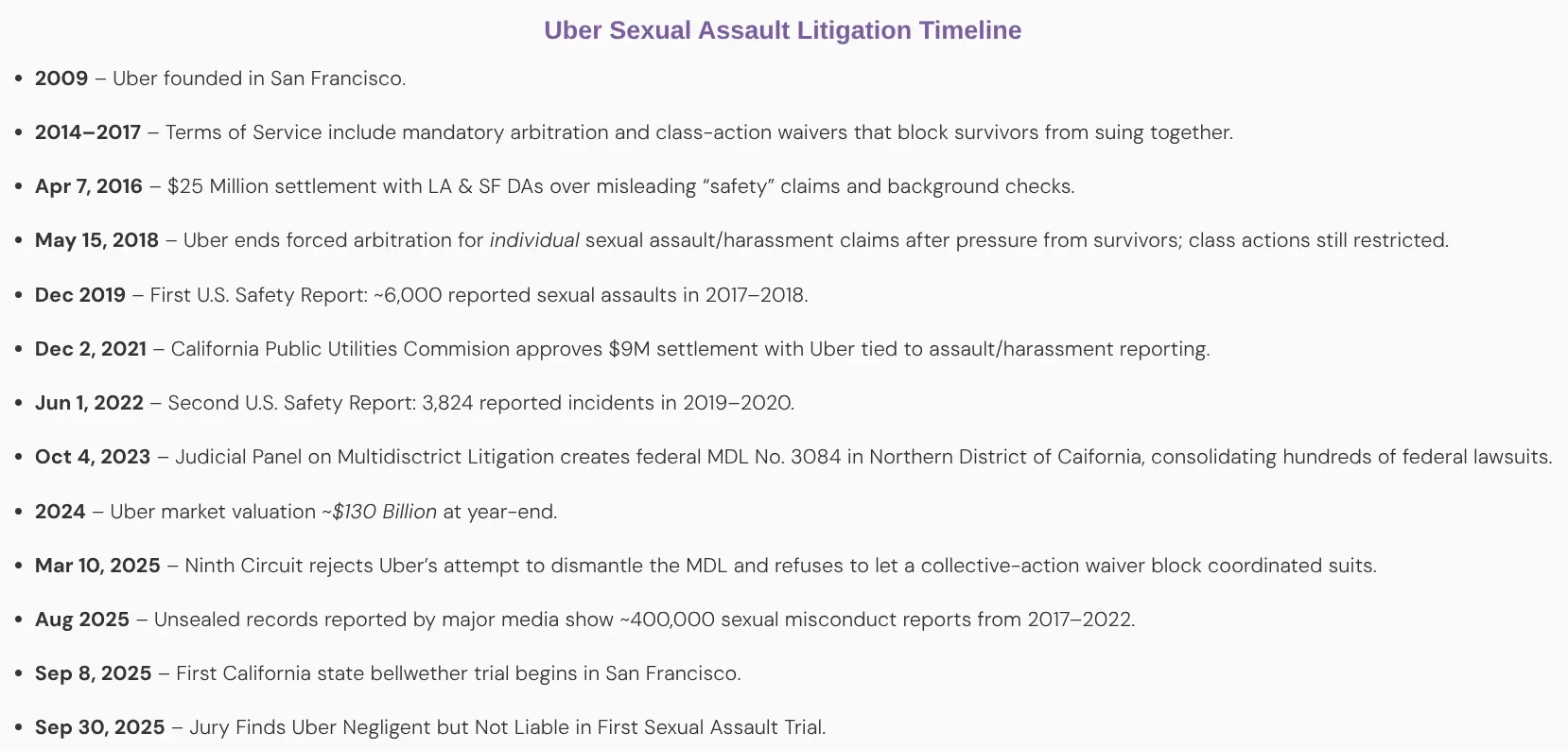
A timeline of the Uber sexual assault litigation (created by Judd Handler, editor of SurvivorsRights.com) shows how years of reported incidents, policy changes, and mounting lawsuits culminated in multidistrict litigation and ongoing courtroom battles. For law firms, each of these developments should serve as a new entry point for potential clients searching for answers. When this kind of evolving timeline is built into a broader pillar page strategy, it transforms static content into a living resource that captures high-intent traffic as the case unfolds, strengthening authority and creating multiple pathways for qualified leads.
Most law firm websites are filled with static content. A practice area page such as personal injury or immigration gets published. Maybe a few blog posts are added. Then everything sits there while the actual litigation the firm cares about continues to evolve in real time. Relatively few law firms keep up with developing litigation. And even the ones that do fail to capitalize on it.
When a case is active, expanding, or making headlines, people are searching. Not just broadly, but very specifically. They’re looking for updates, context, and answers tied to what they just saw or experienced.
If your website doesn’t reflect what’s happening right now, you’re invisible at the exact moment potential clients are paying attention.
The Problem With “Set-It-and-Forget-It” Legal Content
Most firms invest in a long-form page targeting a high-value keyword, publish it, and assume it will carry the load indefinitely. But in competitive legal verticals such as mass torts or institutional abuse cases, that approach falls short, because the search landscape changes constantly:
New lawsuits get filed
Additional states or jurisdictions take action
Investigations uncover new facts
Media coverage shifts public awareness
Meanwhile, the firm’s content stays frozen in time.
How To Exploit Ongoing Litigation In Content Marketing
Instead of treating content as a static asset, treat it as something that should evolve alongside the case.
The foundation is still a strong, comprehensive pillar or cornerstone page. A pillar/cornerstone article should serve as an authority page on a particular area of litigation or practice that clearly and thoroughly explains the legal issue so it can serve as the central resource for both search engines and potential clients.
For example, consider this “Roblox Lawsuit Guide” It explains the basics of the litigation, including the allegations, history of the litigation, who may qualify, and what legal options are available; supporting articles build around this pillar article.
From there, I build out a layer of supporting content tied to real developments.
For example, if a new lawsuit is filed by a state attorney general, that becomes a focused article that I can link to in the pillar article. If multiple jurisdictions begin taking similar action, that becomes another. If new allegations or investigative findings emerge, those are covered as well, and so on.
Each piece is written to stand on its own, but it also strengthens the larger topic by linking back to the core page and reinforcing relevance.
Over time, this creates a content structure that reflects the actual trajectory of the litigation, not just a snapshot of it.
What This Looks Like in Practice
On SurvivorsRights.com, I’ve been applying this approach to other areas of litigation, mostly falling under the umbrella of institutional abuse cases. (See: Uber litigation, Troubled Teen Industry (TTI) lawsuits, competitive cheer, and Catholic Church sexual abuse lawsuits and settlement guide as examples.)
Rather than relying on a single evergreen page, I’ve continued publishing updates tied to real-world developments, such as new lawsuits, settlements, expanding claims and regulatory action.
Each article is intentionally connected to a broader guide. That means when someone searches for a specific update, they don’t just land on a news-style post. They’re also one click away from a deeper resource that explains their legal options.
This structure kills two birds with one stone. It captures timely, high-intent traffic while building long-term authority around the core topic.
How Ongoing News Helps Expand Lead Generation
When people search for legal topics tied to breaking news, they are often much closer to taking action than someone doing general research.
They may have just learned about the issue. They may be trying to understand whether it affects them or their family. They may already be considering legal options.
If your content shows up in that moment and provides both clarity and a path forward, the likelihood of engagement is significantly higher.
By contrast, firms that rely only on static pages miss that window entirely.
This approach isn’t just about traditional SEO. It also aligns with how AI-driven search and answer engines (AEO/GEO; answer engine optimization and generative engine optimization) evaluate content.
Systems that generate summaries and recommendations are increasingly prioritizing:
Topical depth
Recent content
Context across multiple related pieces
A single page, no matter how well written, is less likely to perform as strongly as a connected body of content that demonstrates ongoing coverage and understanding of a subject.
The Bigger Picture For Law Firm Content
Most firms don’t need more content for the sake of content.
What they need is content that reflects how legal cases actually unfold over time, with new developments, new claims, and new opportunities to connect with potential clients.
That requires more than writing ability (not to be understated; skilled writing is critical!), understanding how litigation evolves, how people search, and how to structure content so it works together instead of sitting in isolation.
That’s the gap Law Firm Content Manager fills for attorneys and small-to-mid-size firms.
Turn Your Legal Content Into a Lead-Generating Asset
Most law firm websites rely on static content that quickly becomes outdated. If your practice areas involve ongoing litigation, evolving claims, or expanding cases, your content should reflect that.
We offer a free content audit and strategy session to help identify gaps, uncover missed opportunities, and show how your existing content can be transformed into a system that attracts higher-intent leads.
