
How To Make Your Law Firm’s Practice Area Pages Stand Out
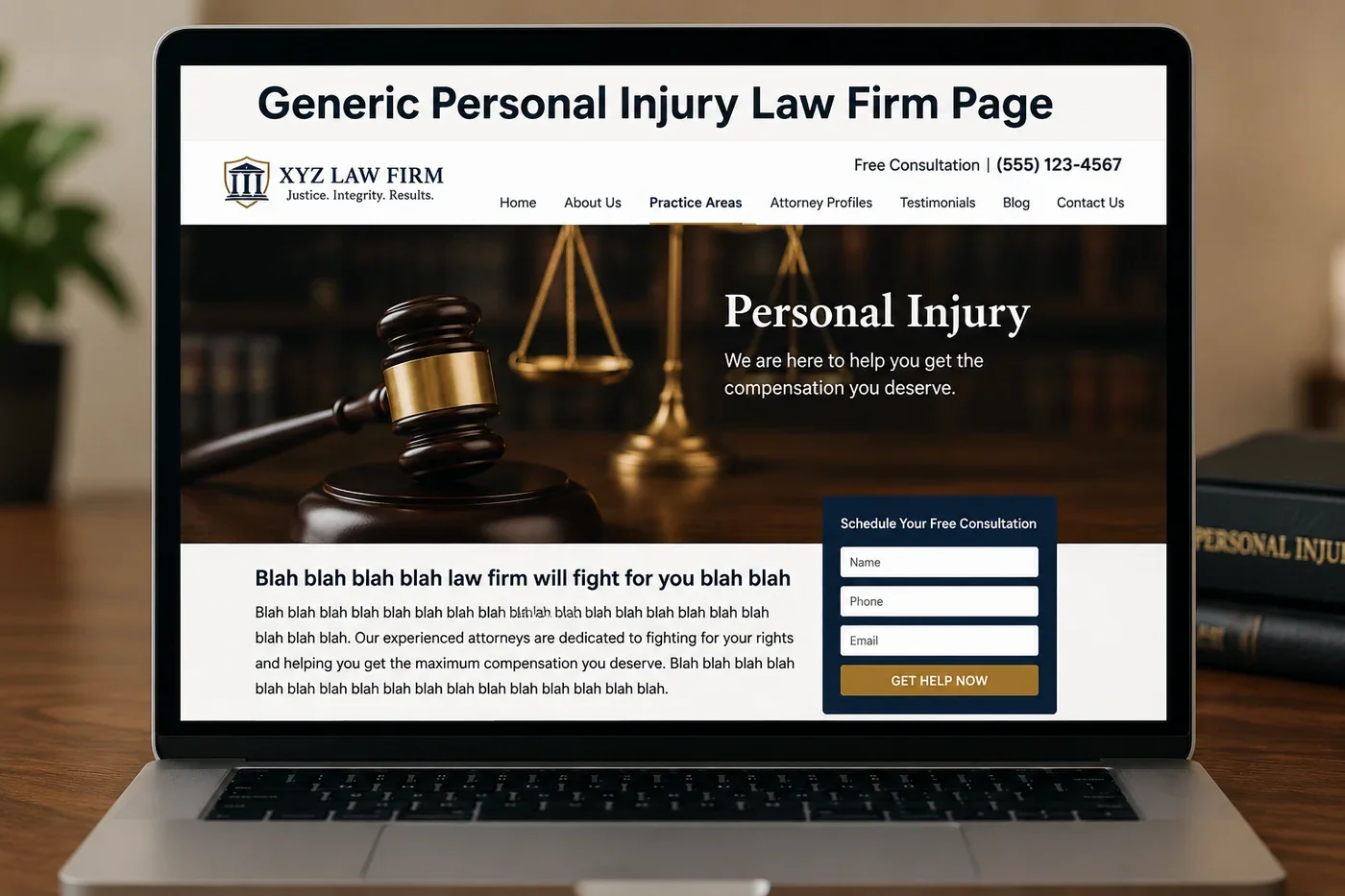
Generic legal copy makes every law firm sound the same. Distinctive practice area pages address real client concerns and give prospective clients a reason to remember and trust your firm.
Let’s say your general practice law firm handles personal injury cases.
Pull up your firm’s personal injury practice area page. Then open the corresponding pages from a dozen competing firms in your geographic area.
What do you notice? Take a moment to put yourself in the shoes of someone who was recently injured and is researching possible attorneys. After reading several of these pages, that person may come to one unavoidable conclusion:
Every law firm sounds the same.
The wording changes slightly, but the message usually boils down to something like this:
“Have you been injured in an accident? Our experienced attorneys will fight tirelessly to obtain the maximum compensation you deserve.”
There’s nothing inherently wrong with that message. The problem is that prospective clients may encounter essentially the same promise on five, ten, or twenty other law firm websites.
If every page reads like an advertisement, what helps someone decide which firm to contact?
Perhaps it comes down to office location. Maybe one attorney has a friendlier headshot. Maybe the visitor simply calls the first firm that answers the phone.
Those factors may influence the decision, but there is no reason to leave the outcome entirely to chance.
A much better approach is to create practice area pages that give prospective clients a genuine reason to remember and trust your firm.
Stop Writing for an Imaginary “Injured Person”
A personal injury page written for anyone who has been injured probably won’t deeply connect with somone seeking a PI attorney.
Consider how different these prospective clients may be:
A construction worker injured by defective equipment
A parent whose child was bitten by a neighbor’s dog
A rideshare passenger hurt in an Uber collision
A motorcyclist blamed for an accident he did not cause
A family trying to understand whether a loved one’s death may support a wrongful-death claim
They may all need a personal injury attorney, but they are not asking the same questions. They do not share the same fears, and they will not necessarily respond to the same message.
A strong practice area page identifies the people most likely to need that particular service and speaks directly to their circumstances.
That does not mean stuffing every conceivable accident type onto one enormous page. In many cases, it means creating separate, substantive pages for distinct case types and client concerns, while using the main practice area page as a broader overview. Try to match each page to a specific search intent rather than forcing every prospective client into the same generic message.
Match the Page to What the Prospective Client Wants to Know
A prospective client rarely begins by wondering how many aggregate years of experience a law firm’s attorneys possess.
They are more likely to be asking:
Do I actually have a case?
Who may be responsible?
How will I pay my medical bills?
What happens if the insurance company blames me?
Is it too late to file a claim?
What will hiring an attorney involve?
Has this firm handled situations similar to mine?
Your page should plainly answer those questions (not in legalese).
Translate complex legal terms into information that helps a worried or confused person understand what may happen next. (This is one area where AI can be useful, however, you still need an intelligent actual human to fine-tune the copy.)
Ultimately, a successful personal injury (or any practice page) feels less like a billboard and more like the beginning of a useful conversation.
Explain What Is Different About Your Firm’s Approach
Most firms claim to provide personal attention, aggressive representation, and exceptional service.
Those phrases have become nearly meaningless because everyone uses them.
Instead of telling readers that your firm provides personal attention, explain what that looks like.
Does the client communicate directly with a partner attorney, junior attorney or the paralegal? How quickly are calls returned? Who handles day-to-day questions? Does your firm deliberately limit its caseload? Will the attorney prepare every case as though it could proceed to trial?
Specifics are far more persuasive than adjectives.
Compare these two statements:
We provide personalized and compassionate legal representation.
And:
You will receive your attorney’s direct contact information and regular updates as your case progresses. You will not be left wondering who is handling your claim or what happens next.
The second version gives “personalized representation” an actual meaning.
Use the Firm’s Real Experience
A distinctive practice area page should contain information that could not be copied and pasted onto another law firm’s website without someone noticing.
That may include:
A representative case result
A recurring problem the attorneys see in these claims
A common mistake clients make before contacting the firm
The firm’s process for investigating the case
An anonymized client scenario
Insights drawn from the attorney’s experience with local courts, insurers, employers, or opposing counsel
This is where attorney input becomes invaluable.
A writer can research the law and an AI platform can summarize it in seconds. Neither automatically knows what your attorneys have learned from handling cases over the past several years, and those details are what make the page original.
Address the Concerns Other Firms Ignore
Many practice area pages cover the legal basics but avoid the questions people are uncomfortable asking.
How much will an attorney cost?
How long could the case take?
Could pursuing a claim damage a business relationship?
Will the client have to appear in court?
What happens if the available recovery is limited?
Can the firm guarantee a particular result?
Answering difficult questions does not weaken the sales message. Rather, it demonstrates honesty and helps visitors decide whether your firm may be the right fit.
You do not need to provide an absolute answer when the answer depends on the facts. Saying that clearly can be more credible than delivering another sweeping promise.
Make Local Relevance Meaningful
Adding a city name to the title and repeating it throughout the copy does not automatically create a useful service-area page.
Local relevance should add substance.
Depending on the practice, that might mean discussing:
The courts that may hear the matter
State-specific deadlines or procedural rules
Local industries connected to certain claims
Frequently traveled roads where accidents occur
Government agencies involved in the process
Regional employers, property types, or business concerns
The geographic area the firm actually serves
Include genuinely useful information to someone seeking legal help in that location.
Write Like a Knowledgeable Human Being
Legal content needs to be accurate, but it does not need to sound like a legal brief.
Overly formal language creates distance at the exact moment your firm should be establishing a connection.
Prospective clients usually do not search for an attorney because everything is going well. They may be injured, frightened, angry, financially strained, or unsure whether their problem is even serious enough to call a lawyer.
Good legal content acknowledges that reality without becoming melodramatic.
Empathy does not require lines such as, “We understand this is a difficult time.” It can be demonstrated by anticipating the person’s concerns, explaining the process clearly, and avoiding language that makes a stressful situation even harder to understand.
Add Questions That Reflect Real Search Intent
Every practice area page should include common questions and answers. The reason is twofold: they help prospective clients quickly find the information they are actually seeking, and they make it easier for search engines and AI-powered tools to understand the page and surface relevant information.
Include questions that prospective clients genuinely ask during intake calls, consultations, emails, and online searches.
The answers can address narrower, conversational queries that may not fit naturally into the main copy. They also give your firm another opportunity to demonstrate knowledge, anticipate concerns, and explain complicated legal issues in plain English.
Where appropriate, those visible questions and answers can be supported with structured data such as JSON-LD. This backend code gives search systems machine-readable information about the page’s content. It does not guarantee rankings, rich results, or inclusion in an AI-generated response, but it can help search platforms interpret and organize the information more effectively.
In other words, do not add backend code to compensate for thin answers. Start with useful questions and substantive responses. Then use valid structured data to help search systems understand what is already visible on the page.
(LawFirmContentManager.com uses AI-assisted tools to generate this code, reviews it for accuracy, and adds it to the backend of your content management system.)
Conclusion: Your Practice Area Pages Should Give People a Reason to Choose You
A practice area page should do more than confirm that your firm handles a particular type of legal matter.
It should help prospective clients recognize their situation, understand their options, and see why speaking with your firm may be worthwhile.
That requires more than changing a few headings on the same generic template used by every competitor.
Your firm does not need to sound louder than every competitor. Instead, it just needs to sound more useful, more credible, and more human.
Do Your Practice Pages Need A Tune Up?
We develop original, human-edited legal content based on your services, experience, geographic markets, and prospective clients’ real questions. Contact us to discuss your law firm’s content strategy.
