
How To Easily Explain Uber’s Attempts To Escape Liability To Survivors
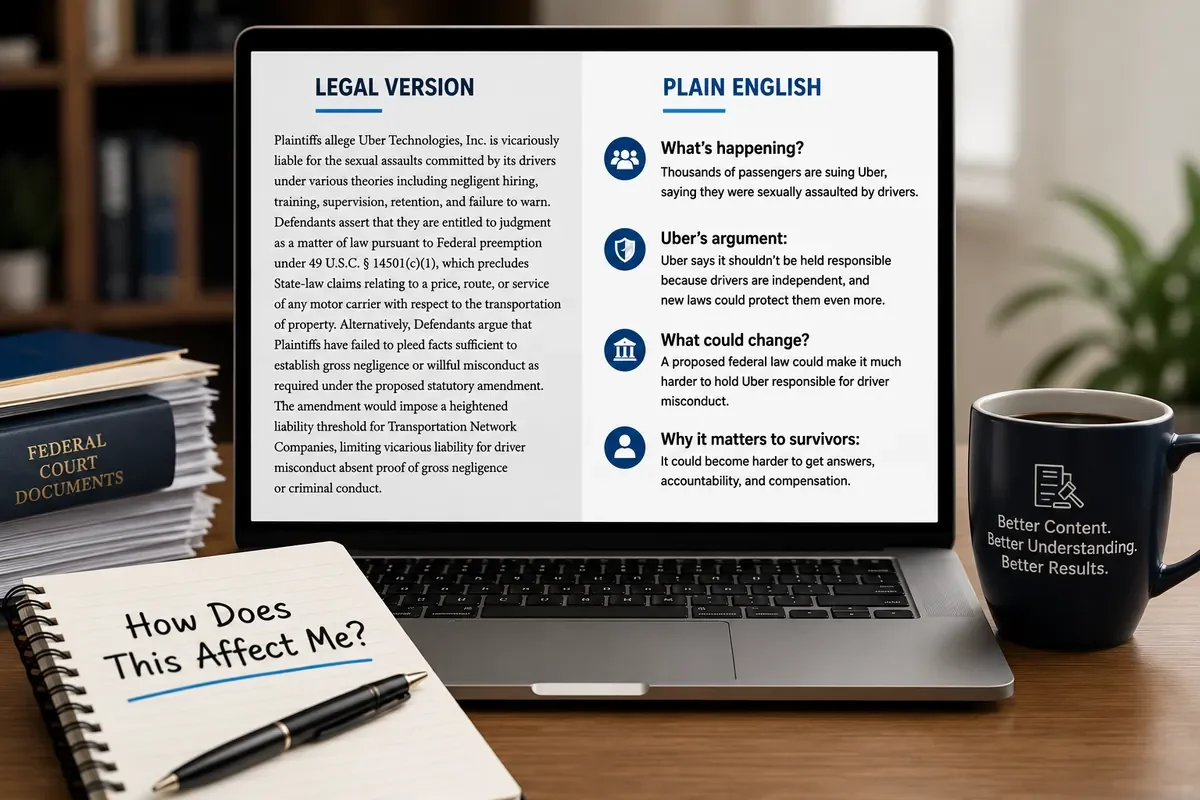
Valuable legal content does more than summarize litigation. It helps potential clients understand what happened, why it matters, and how the case may affect the, without forcing them to decode legal jargon.
Most survivors do not wake up wondering about federal transportation bills, liability shields, preemption, bellwether verdicts, or contingency-fee economics.
They wonder something much simpler:
If Uber knew passengers were being assaulted, why is it so hard to hold the company accountable?
That is the question legal content should answer.
And yet, when you read much of the mass tort content being published around the Uber sexual assault litigation (read my complete coverage here on SurvivorsRights.com), the explanations often sound like they were written for lawyers, not survivors. The pages may be technically accurate and include the right keywords for SEO. Additionally, they may mention the MDL, the latest motions, the number of claims, and the procedural posture.
But they often fail at the most important job:
They do not make the story easy to understand.
What Is Happening With Uber Right Now?
Uber is already facing thousands of sexual assault and harassment lawsuits from passengers who allege they were harmed by Uber drivers.
Those lawsuits are not just about whether an individual driver committed assault.
They are about whether Uber, as a company, should be held responsible for the safety of passengers using its platform.
That is the larger fight.
Uber’s position, broadly speaking, has often been that it is a technology platform connecting riders and independent drivers. In that framing, Uber is not the same as a taxi company, bus company, or transportation provider with more direct responsibility for passenger safety.
Plaintiffs and survivor advocates see it differently.
They argue that Uber is not some passive app floating in the cloud. Uber built the system. Uber controls the platform. Uber sets the rules. Uber profits from the rides, receives complaints, has access to safety data, and decides which safety measures to implement, delay, reject, or promote.
So the real question is not simply, “Did a driver do something wrong?”
Instead, the more urgent question is what did Uber know, and what did Uber do about it?
That is the question that a survivor can relate to.
The New Federal Transportation Bill Fight, Explained Simply
The latest development is that Uber’s liability fight has now reached Congress.
California congressman Vince Fong (R-Bakersfield) introduced an amendment to a major federal transportation bill that would make it much harder to hold rideshare companies responsible for harm caused by their drivers.
For survivors, the simple version is this:
Under the proposed amendment, a passenger harmed by a rideshare driver may have to prove that the company itself was grossly negligent or engaged in criminal wrongdoing before the company could be held responsible.
That is a much higher bar than many ordinary negligence claims.
In everyday language, Uber would be able to argue:
“The driver may have done something terrible, but we should not be legally responsible unless you can prove we were extremely careless or criminally involved.”
That is the point survivors need explained instead of wrapped in legal jargon. But I’ve seen some mass tort firms describe it like so: “federal preemption implications in transportation-related civil claims.”
I’m not even sure every body with a J.D. understands that.
How This Could Change The Path To Accountability
If a mass tort firm that wants to expand their plaintiff docket really wants to convey empathy, they should include questions that a survivor may ask on their website coverage of the litigation.
For instance:
Did Uber know other passengers had reported similar incidents?
Were there warning signs about this driver?
Were background checks strong enough?
Did Uber respond properly to prior complaints?
Were riders given enough safety protections?
Did Uber choose growth, convenience, or profit over passenger safety?
A Better Way To Explain Uber’s Liability Strategy
Here is how I would explain Uber’s strategy to a survivor in plain English:
Uber is not just defending itself in court. It is also trying to change the rules that decide when it can be sued.
Uber is facing thousands of claims. Some cases have already gone to trial. One early federal trial resulted in an $8.5 million verdict. Another trial produced a much smaller $5,000 award. Those mixed results matter because early trials help both sides understand how juries may respond to the evidence.
But Uber is not waiting for every case to play out in court.
The company and its allies are also supporting efforts that could limit lawsuits, reduce attorney fees, narrow corporate responsibility, or make it harder for passengers to bring claims in the first place.
These are the issues that survivors need to understand because the Uber driver sexual assault MDL is not just a courtroom fight. As Rep. Wong’s legislation proves, the drama also spills over into politics.
Where Mass Tort Content Fails Survivors
Many mass tort firms cover litigation updates like they are writing for other mass tort firms.
They say things like:
“Recent developments in the Uber MDL may impact the viability of claims involving rideshare sexual assault allegations.”
That may be accurate. But it really lacks empathetic connection with survivors.
A survivor may not know what “viability of claims” means. A family member trying to help their daughter, spouse, or friend may not know what an MDL is. Even attorneys outside the mass tort space may not immediately understand how a federal transportation amendment could affect sexual assault cases.
So why not say it plainly?
Here’s how I would frame it:
“Uber is facing thousands of sexual assault lawsuits. Now, the company’s supporters are backing legal changes that could make it harder for survivors to sue Uber, even when the alleged assault happened during a ride arranged through the app.”
Legal Jargon Versus Survivor-Centered Explanation
Or consider this legalese:
“Proposed federal legislation may impose heightened liability thresholds for transportation network companies in driver misconduct cases.”
Now here is the same idea in survivor-centered language that I would employ for a firm:
“Congress is considering a change that could make it much harder for passengers to hold Uber responsible when they are harmed by drivers.”
Which one is more likely to help a survivor understand what is happening?
Another example:
“The amendment may affect claims predicated on negligent hiring, supervision, retention, and failure to warn theories.”
Compare that J.D.-esque coverage to:
“Many lawsuits argue that Uber failed to do enough to screen drivers, respond to complaints, warn passengers, or prevent known safety risks. The proposed amendment could make those arguments harder to bring.”
It’s not written for a 10 year old but still much easier to comprehend….
Simpler Content Builds More Trust
Simplicity is critical in survivor-focused litigation.
Survivors are not shopping for law firms based on their knowledge of legal arcana. Instead, they are often trying to understand something painful, confusing and overwhelming. All of which means a survivor may not be ready to call a lawyer or know whether what happened to them “counts” and if they have a case. Furthermore, a survivor may feel embarrassed, skeptical, angry, or afraid of not being believed.
Thus, if the first thing they read is a wall of legal jargon, they may decline to learn more about their legal rights and options.
What Plaintiff Firms Should Explain
If a law firm is covering the Uber sexual assault litigation, it should not only publish updates that say, “Here is what happened.”
It should explain how the recent development impacts survivors.
For example:
What happened: A federal amendment was introduced that could limit rideshare company liability.
What it means: Uber may have a stronger argument that it cannot be held responsible for driver misconduct unless survivors meet a much higher legal standard.
Why survivors should care: If the law changes, it may become harder to bring certain claims or hold Uber accountable for alleged safety failures.
What remains unclear: The amendment is not final, litigation is ongoing, and courts may still need to decide how any new law applies to pending cases.
This structure makes it simple for survivors to follow.
It is also the kind of structure Google, AI search tools, referral partners, and journalists can understand.
The Real Content Lesson
The Uber sexual assault litigation is a reminder that legal content should serve the reader first.
For mass tort firms, that means explaining litigation in a way that answers the questions real people are actually asking:
What happened?
What does it mean?
Could this affect me?
Why is the company fighting this?
What should I understand before I contact a lawyer?
In virtually every industry, it helps to remember the acronym, KISS.
Keep it Simple, Sally!
Mass torts and the law in general is no exception.
Need Help Turning Complex Litigation Into Client-Friendly Content?
LawFirmContentManager.com helps plaintiff firms explain complicated lawsuits, mass tort updates, and survivor-focused litigation in plain English so potential clients understand what happened, how it affects potential plaintiffs, and how your firm can help.
Speak With A Legal Content Strategist